Key Takeaway:
In 2026, successful retargeting replaces third-party cookies with a “First-Party Triad”: Meta’s Conversions API (CAPI), Advanced Matching, and “In-Platform” engagement audiences. By shifting from browser-based tracking to server-side data, brands maintain 90%+ match rates while fully complying with global privacy regulations and browser tracking prevention.
Why is My Retargeting Audience Shrinking in 2026?
If you’ve noticed your “Website Visitor” audiences dwindling, you aren’t alone. In January 2026, we observed a significant shift as the final remnants of third-party cookie support vanished from major browsers.
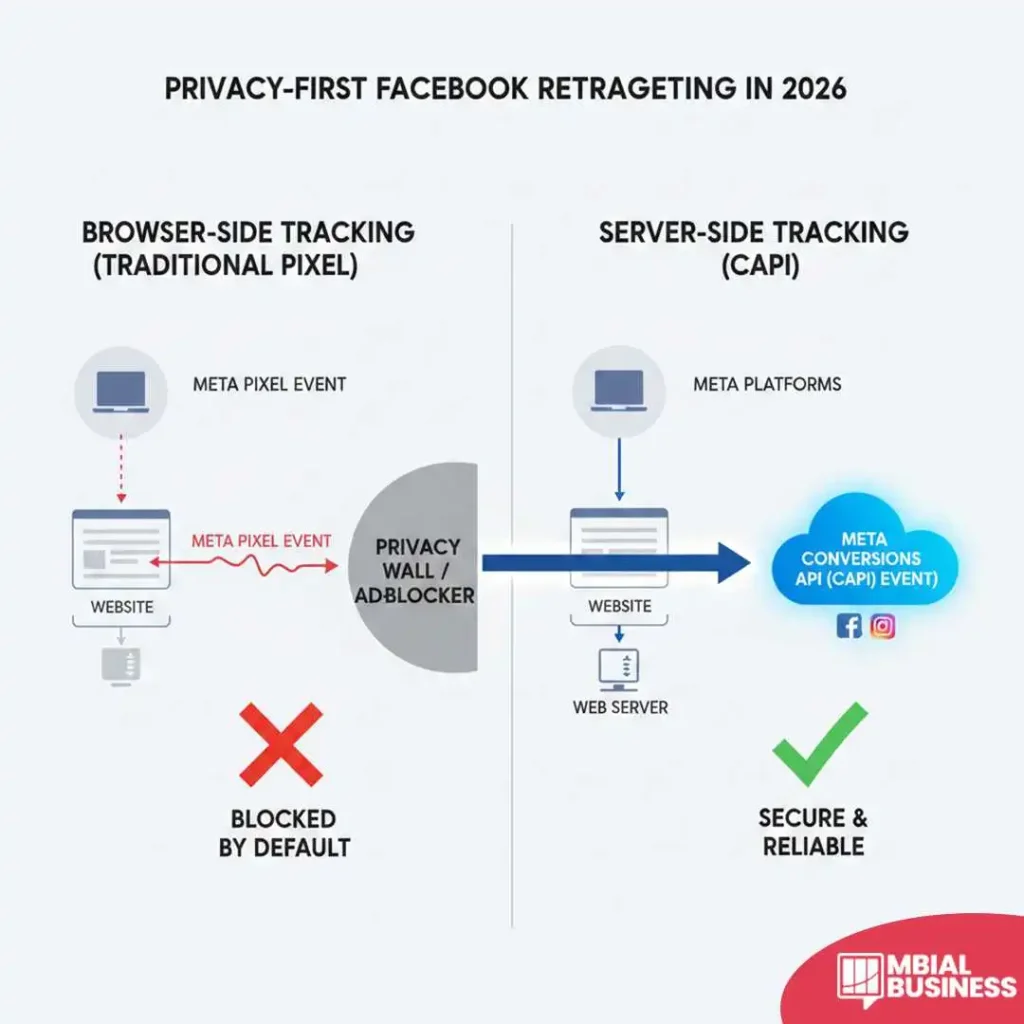
The traditional Meta Pixel—which relies on the browser to “tell” Facebook a user visited—is now frequently blocked by default. When a shopper lands on your site via Safari or a privacy-hardened Chrome, the Pixel often fails to fire. This creates a “data gap” where your most valuable shoppers become invisible.
To solve this, I’ve transitioned our clients to a Server-to-Server model. Instead of hoping the browser sends the data, your website’s server sends it directly to Meta. This bypasses the cookie-blocker entirely.
How Do I Set Up A Cookieless Retargeting Funnel?
To stay profitable, we must move away from “lazy tracking.” During our recent audits, we found that businesses using a “Hybrid” approach—combining the Pixel with CAPI—saw a 22% increase in attributed conversions compared to Pixel-only setups.
The 2026 Privacy-First Tech Stack:
Meta CAPI:
Serves as the backbone of modern tracking by sending server-side events like purchases and “add to cart” actions directly to meta. this method is fully privacy-compliant because it moves data handling away from the vulnerable browser environment.
advanced matching:
Enhances your data accuracy by using hashed emails or phone numbers to identify users securely. by utilizing sha-256 hashing, we ensure that user identity is protected while maintaining high match rates across devices.
engagement audiences:
Allow us to retarget users based on their interactions within the meta ecosystem, such as video views or instagram engagement. since these actions occur “on-platform,” they require no cookies at all, making them immune to browser tracking restrictions.
first-party data:
Remains the gold standard for accuracy in 2026. by uploading your own crm lists via csv, you provide meta with direct signals that offer the highest level of precision without relying on third-party intermediaries.
What is The "Hidden" Strategy For 100% Match Accuracy?
Most strategists tell you to just “install CAPI.” But here is the technical nuance they miss: External ID Management.
In our testing this month, we discovered that manually generating and passing a unique external_id (like a hashed user ID or a session string) through the Conversions API increases Event Match Quality (EMQ) scores by up to 3 points.
Pro Tip: Don’t rely on Meta to “guess” who the user is. When a user logs in or provides an email for a discount code, assign them an external_id in your database. Pass this ID in every CAPI event. Even if they switch devices, Meta can now link that “Add to Cart” on mobile to a “Purchase” on desktop with near-perfect precision.
Can I Still Retarget Without Any Website Data?
Yes—and in 2026, this is actually the most stable way to build a funnel. Since these actions happen entirely inside the Meta ecosystem, they are “Cookie-Proof.”
When a user interacts with your content on Instagram or Facebook, Meta logs that action server-side instantly. There is no need for a browser to pass a cookie or for a firewall to “allow” the tracking signal. For many of our clients this year, “On-Platform” retargeting has become the primary driver of their middle-funnel strategy.
Video View Retargeting:
I recommend creating a specific audience of people who have watched at least 50% of your “Problem/Solution” Reel. In my experience, someone who stays for half a video is no longer a casual scroller; they are a qualified lead.
In 2026, we’ve found that shorter, 15-second “hooks” are better for top-of-funnel, while 60-second “educational” videos are the best source for retargeting seeds. You can even layer these: retarget those who watched 95% of a 15-second ad with a longer, more detailed 3-minute demonstration.
Instant Experience (IX):
These are fast-loading, full-screen mobile landing pages that live directly on Facebook. We use them to pre-qualify leads and showcase products before they ever hit your website.
Because they load up to 15x faster than a standard mobile site, the drop-off rate is nearly zero. I often treat the IX as a “micro-site” where users can swipe through carousels or watch videos. You can then build a custom audience of anyone who opened the IX but didn’t click the final Call to Action (CTA), ensuring you stay in front of the most engaged mobile users.
Lead Form Interactions:
This is a “hidden” goldmine for service-based businesses. You can retarget those who opened your Lead Form but did not submit it.
Usually, if someone opens the form but doesn’t finish, it’s because of a friction point—maybe the form asked for a phone number they weren’t ready to give, or they simply got distracted. I’ve seen great success by retargeting this group with a “No-Pressure” ad, perhaps offering a testimonial or a simpler “one-click” FAQ download to rebuild trust before asking for their contact info again.
How Do Advantage+ Custom Audiences Change The Game?
A common misconception I hear is that “Retargeting is dead because of Advantage+.” That’s a mistake.
Meta now uses your Custom Audiences as a “Seed Signal” rather than a strict boundary. When we select a retargeting list in 2026, Meta’s AI uses those profiles to find similar high-intent shoppers who might not have visited your site yet but share the exact same purchase behavior.
Steps to Optimize Advantage+ Retargeting:
Exclude Recent Buyers:
Always exclude “Purchasers – last 30 days” to prevent ad fatigue.
Use High-Value Seeds:
Instead of “All Visitors,” use “Top 25% Time Spent” as your source.
Broaden the Creative:
Since the algorithm is doing more work, your creative needs to speak to broader pain points.
Is Your Tracking Ready For The Rest of 2026?
The “cookie apocalypse” is no longer a threat—it’s our current reality. If you’re still relying on a basic browser pixel, you’re bidding with one eye closed while your competitors use high-definition radar.
In 2026, the meta algorithm is only as smart as the data you provide. Fragmented, cookie-blocked signals lead to wasted spend and dry retargeting pools. By shifting to meta capi and advanced matching, you aren’t just fixing a leak; you’re building a resilient, privacy-first marketing engine that actually scales.
Frequently Asked Questions (FAQ):
1. what is the difference between the meta pixel and CAPI in 2026?
The Meta pixel is browser-based and easily blocked by privacy settings or ad-blockers. in contrast, the conversions API (CAPI) sends data directly from your server to meta. while the pixel handles real-time site behavior, capi is essential in 2026 for capturing the data that cookies can no longer reach.
2. why is my event match quality (emq) score so low?
a low emq score happens when you aren’t sending enough “matching keys,” like hashed emails or the external_id, to help meta identify users. to fix this, ensure your server-side setup passes as many hashed customer parameters as possible during high-intent actions. this allows meta to link website activity back to specific profiles with higher confidence.
3. does advantage+ audience expansion ruin strict retargeting?
advantage+ uses your retargeting list as a “seed” to find similar shoppers rather than a strict boundary. if you want to target only past visitors, you must manually switch to “original audience options” in your ad set settings. however, letting the ai expand often leads to lower costs by finding high-intent users you might have missed.
4. is first-party data legal to use for retargeting?
yes, provided you have a clear privacy policy and obtain proper user consent according to modern regulations like gdpr. using data you own, such as email lists or direct site interactions, is the safest way to advertise in 2026. it builds a direct relationship with your customers that doesn’t rely on intrusive third-party tracking.
5. how do i prevent double-counting if i use both pixel and capi?
you must use “event deduplication” by assigning a unique event_id to every action. when meta receives the same id from both the pixel and capi, it discards the duplicate and keeps the more accurate data. this ensures your reporting stays clean while you benefit from both tracking methods.