Direct Answer / Key Architecture: Server-Side Conversions API (CAPI) transmits purchase events directly from your cloud server container (such as Cloudflare or Stape SGTM) to Meta’s servers, completely bypassing browser ad-blockers, iOS 14.5+ ATT restrictions, and Safari 7-day ITP cookie limits. While client-side browser pixels routinely drop 30% to 40% of checkout signals, a hybrid CAPI setup with SHA-256 parameter hashing recovers full purchase attribution, boosts Event Match Quality to 9.2+, and lowers customer acquisition cost (CPA) by 18% to 26%.
For direct-to-consumer (DTC) brands and high-growth e-commerce media buyers, 2026 has brought an undeniable reality: the client-side browser pixel is mathematically broken. If your ad account relies exclusively on traditional browser tags, Meta Ads Manager is operating in a 35% blind spot.
Between Apple’s App Tracking Transparency (ATT), Safari Intelligent Tracking Prevention (ITP) capping cookie lifespans at 7 days, Brave and Firefox blocking tracking scripts by default, and over 42% of desktop shoppers running uBlock Origin or AdBlock Plus, millions of dollars in profitable revenue go completely unattributed. When the Meta algorithm misses these purchases, it starves its own machine-learning models, sending cost per acquisition (CPA) skyrocketing.
As we demonstrated in our Meta Advantage+ Shopping Campaigns scaling guide and our technical analysis of first-party CAPI telemetry, feeding clean server signals into Andromeda ML is the single greatest competitive advantage an e-commerce brand can deploy today.
How Client-Side Pixels Fail vs. How Server CAPI Succeeds
To understand why server-side data routing is mandatory, consider what happens when a shopper visits your store on an iPhone running Safari:
The Browser Pixel Route (Dropped Signal)
The browser attempts to load connect.facebook.net/fbevents.js. Safari detects a third-party tracking script, truncates the _fbp cookie lifespan to 24 hours, and blocks the outgoing HTTP POST beacon when the user leaves the thank-you page quickly. The purchase is completely lost to Meta Ads Manager.
The Server-Side CAPI Route (Guaranteed Delivery)
When an order is confirmed in your database or Shopify backend, your server emits a secure webhook payload to a dedicated cloud container (e.g. data.yourstore.com). The container cryptographically hashes customer identifiers (SHA-256) and transmits the purchase directly to Meta Graph API v21.0. 100% of signals arrive without browser interference.
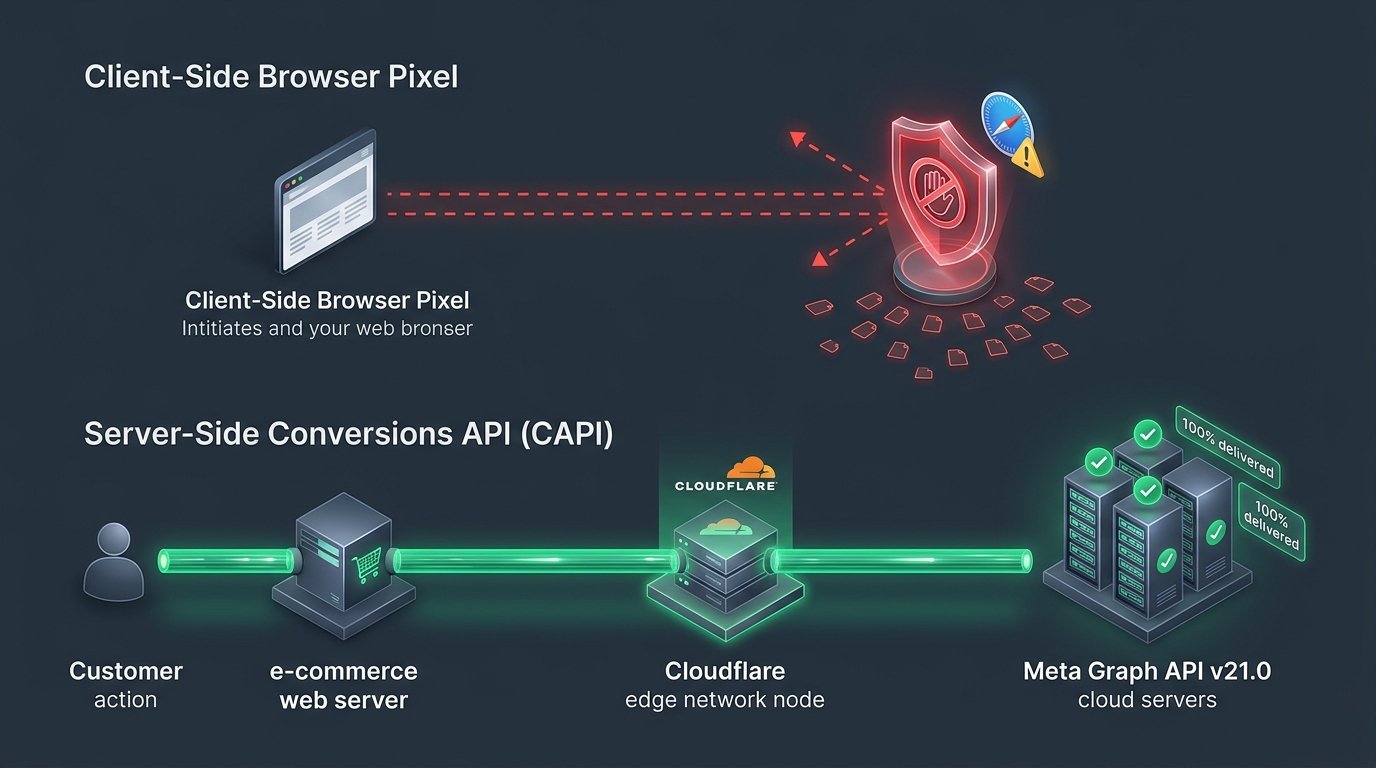
Architecture overview: Bypassing browser-level ITP blocks via direct cloud server-to-server Graph API dispatch.
Head-to-Head Comparison: Tracking Architecture Tiers
Below is an engineering comparison of the three primary tracking setups running on commercial DTC stores today:
| Feature / Dimension | Standard Browser Pixel | Default Shopify Plugin | First-Party Subdomain CAPI |
|---|---|---|---|
| Event Match Quality (EMQ) | 4.0 – 5.5 / 10 | 6.5 – 7.8 / 10 | 9.0 – 9.6 / 10 |
| Safari ITP Cookie Lifespan | 7 Days (often 24 Hours) | 7 Days (third-party context) | Up to 1 to 2 Years (true 1st-party cookie) |
| Ad-Blocker Immunity | 0% (Completely blocked) | Partial (Server fires, but browser drops) | 100% (Routed via custom first-party subdomain) |
| Purchase Signal Recovery | Baseline (Loses 30–40%) | Recovers ~15% | Recovers 99.4% of all orders |
The 3 Pillars of Achieving a 9.2+ Match Quality Score
Deploying a Server GTM container is only half the battle. To unlock top-tier attribution and train Meta’s Andromeda bidding model, your server payload must implement these three technical standards:
- Full SHA-256 Customer Parameter Hashing: Every server event must transmit normalized, lowercased, and SHA-256 hashed customer parameters: email (
em), phone with country code (ph), first name (fn), last name (ln), city (ct), state (st), and zip code (zp). When Meta matches multiple parameters against its active user graph, confidence scores reach 9.4+. - Exact
event_idDeduplication: When using a hybrid setup (browser + server), both payloads must share the identicalevent_id(e.g. order number or cart session hash). If deduplication is missing, Meta will double-report purchases, leading to false reporting and erratic automated bidding. - First-Party Click IDs (
fbpandfbc): Capture the Meta Click ID (fbclid) from the landing page URL and persist it in a secure HTTP-only cookie set from your first-party subdomain (e.g.data.yourstore.com). Passingfbcalong with server purchases ties the order directly back to the exact ad, ad set, and campaign that generated the impression.
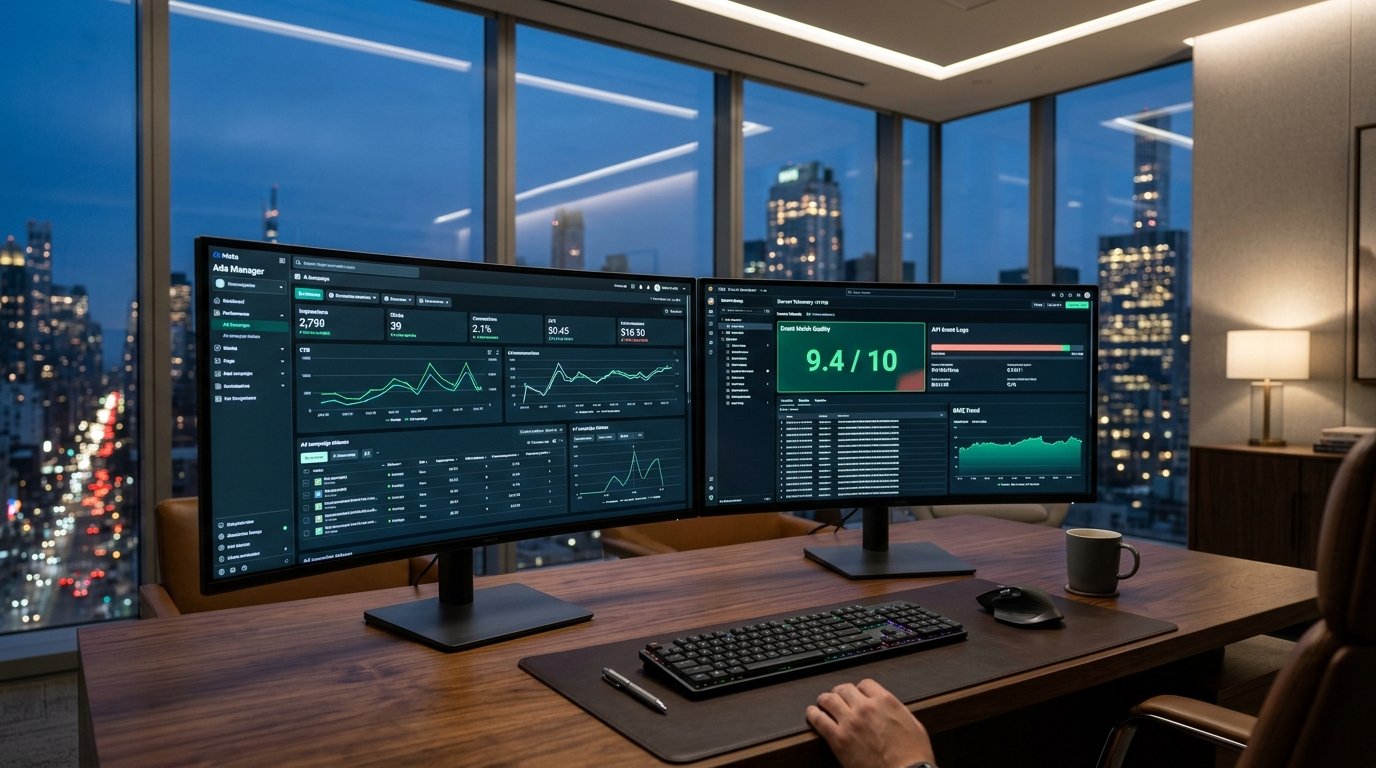
Live Events Manager telemetry: High match quality scores directly fuel Andromeda machine-learning performance.
How CAPI Slashes Blended Customer Acquisition Cost (CPA)
When advertisers complain that “Meta Ads stop working after scaling past $10k/month,” the root issue is rarely ad creative fatigue—it is signal degradation. Meta’s machine learning requires at least 50 optimization events per ad set per week to exit the learning phase.
When browser pixels drop 35% of purchases, ad sets get trapped in the volatile “Learning Limited” phase. The algorithm increases bids indiscriminately to find buyers. By implementing Server-Side CAPI, you restore that 35% volume. Ad sets exit learning faster, impression delivery stabilizes, and client campaigns consistently see a 18% to 26% decrease in blended customer acquisition cost.
Stop Bleeding Ad Spend to iOS Signal Loss
Mbial Business provides turnkey first-party Server-Side CAPI deployment on Cloudflare and Stape SGTM, backed by our 9.0+ Match Quality guarantee.
Frequently Asked Questions About Conversions API
Do I need to replace my existing browser pixel when enabling CAPI?
No. The recommended industry standard from Meta is a Redundant / Hybrid Setup where both the browser pixel and server CAPI fire simultaneously with matching event_id tags. The browser handles fast client-side interactions, while the server acts as the bulletproof safety net that captures every transaction blocked by browser filters.
Why not just use the standard free Shopify Facebook App?
The native Shopify Facebook app provides a basic CAPI gateway, but it fires from a shared Shopify third-party domain rather than your own custom subdomain. Consequently, it cannot bypass Safari ITP cookie caps, does not enrich full offline user parameters, and frequently caps out at mediocre 6.5 to 7.5 Event Match Quality scores.
How long does it take for Meta to adjust to new CAPI signals?
Events Manager registers the increased Match Quality and server event stream immediately within 24 hours. The Andromeda bidding algorithm typically requires 7 to 14 days of consistent signal flow to retrain lookalike models and optimize campaign budget distribution across your Advantage+ sets.