The Direct Answer:
Yes, most full-service digital marketing agencies create content, but the scope varies. while some focus only on strategy, elite agencies provide end-to-end production—including SEO-driven articles, video scripts, and social assets—to ensure your brand’s authority (e.e.a.t.) is backed by high-quality, original data.
Why do Businesses Wonder if Agencies Actually Handle Production?
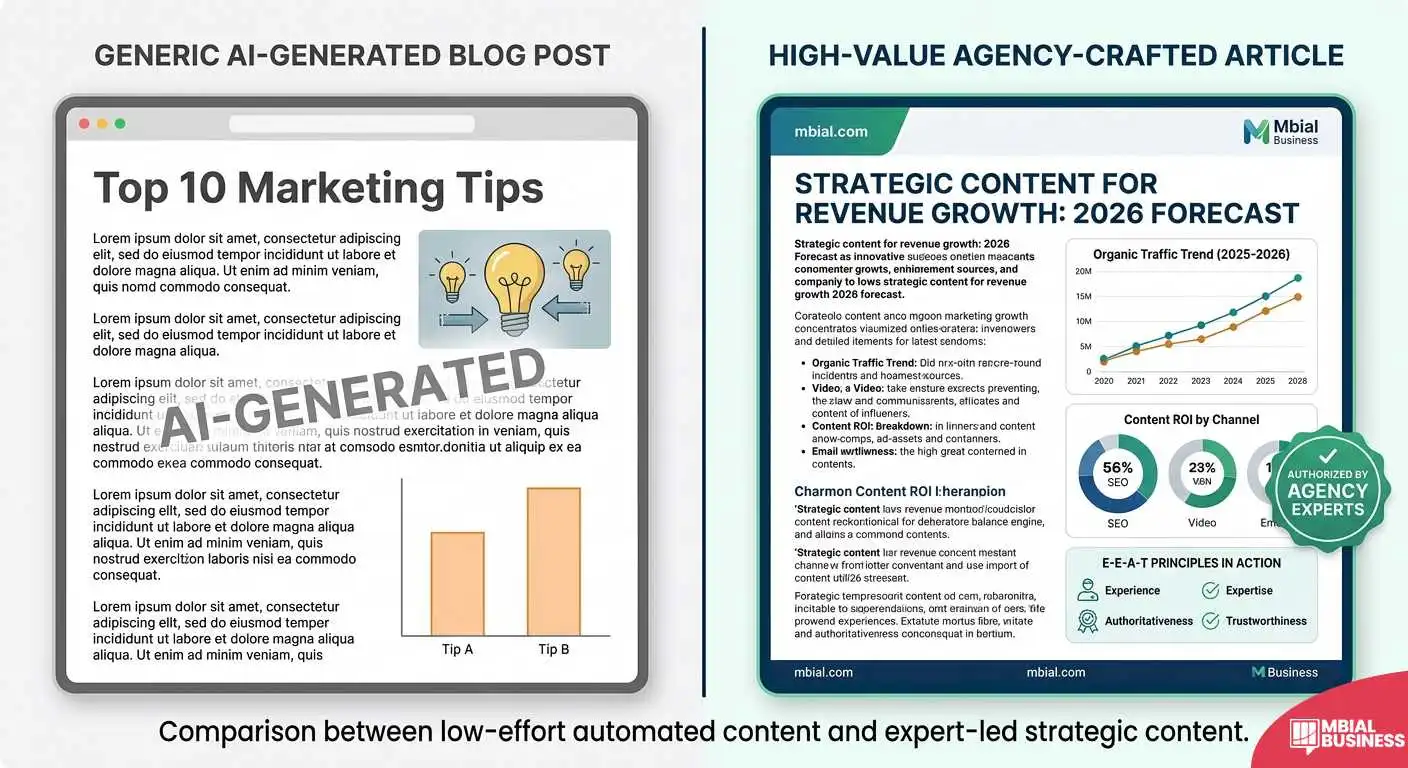
many clients come to us at Mbial Business after a frustrating experience where an agency provided a “content plan” that was just a list of keywords. in january 2026, we observed a massive shift: search engines now penalize generic, ai-fluff content that lacks human oversight.
agencies that “create content” shouldn’t just be writing words; they should be building assets. we’ve found that the most successful campaigns are those where the agency embeds itself into the client’s technical workflow to extract real-world expertise.
What Types of Content do Digital Marketing Agencies Typically Provide?
Not all content is created equal. Depending on your goals—whether it’s raw traffic, lead generation, or closing high-ticket sales—we focus on these four pillars of production:
1. Educational Blog Posts & "Pillar" Pages:
These are the backbone of any SEO strategy. We don’t just write “articles”; we build semantic clusters.
The Goal:
To capture “Top of Funnel” (TOFU) traffic by answering the “how-to” and “what is” questions your customers are searching for.
The Agency Edge:
We use tools to identify “search gaps” that competitors missed. For instance, in early 2026, we’ve found that targeting “Zero-Volume Keywords” (highly specific long-tail phrases) often yields more qualified leads than high-volume generic terms.
2. Video Scripts & Production (The "Social-first" Approach)
Video is no longer optional. Agencies now act as creative directors to ensure your brand translates to vertical formats.
Short-Form (Reels/TikTok):
We focus on “The Hook”—the first 3 seconds that stop the scroll.
Long-Form (YouTube):
We write scripts optimized for “Average View Duration” (AVD).
The Agency Edge:
We don’t just “make a video.” We create a repurposing workflow where one 10-minute interview with you is chopped into 5 Reels, 2 Blog Posts, and a weekly Newsletter.
3. Email Marketing Sequences & Automation:
This is where the “Expertise” of an agency shines. Content here isn’t about being “salesy”; it’s about segmentation.
Nurture Sequences:
Automated emails that trigger when someone downloads a lead magnet.
Abandoned Cart/Service:
Technical workflows that remind users to complete an action.
The Agency Edge:
We implement A/B testing on subject lines and “Send Time Optimization” (STO) to ensure your messages land when your audience is most likely to click.
4. Technical Whitepapers & "E-E-A-T" Assets:
For B2B or high-trust industries, you need “Bottom of Funnel” (BOFU) assets that prove you are the authority.
The Deliverable:
A 10–20 page PDF or interactive web report backed by original data, case studies, or proprietary research.
The Agency Edge:
We handle the “Information Gain” aspect. Instead of citing Wikipedia, we help you package your own internal business data into a report that other websites will want to link to, naturally boosting your site’s authority.
Agency Vs. Freelancer: Who Should Create Your Content?
Choosing between a digital marketing agency and a freelance writer often comes down to the scale of your vision. When you work with an agency, you aren’t just hiring a writer; you are investing in integrated strategy. While a freelancer typically focuses on the “execution only” phase of a brief, an agency aligns every piece of content with your overarching SEO goals and brand identity. This ensures that a blog post isn’t just a standalone text but a functional gear in your marketing machine.
From a technical standpoint, the difference in scalability and tools is significant. Freelancers are inherently limited by a single person’s bandwidth, making it difficult to pivot quickly or handle high-volume demands. Agencies, however, provide diverse teams specializing in design, copy, and technical SEO simultaneously. Furthermore, agencies leverage premium enterprise analytics and advanced AI tools to find data-backed insights, whereas most freelancers rely on more basic, manual research methods.
Finally, the shift in accountability defines the long-term value of the partnership. A freelance writer is generally deliverable-driven, meaning their job ends once they hit a specific word count or finish a draft. In contrast, a professional agency like Mbial Business is KPI-driven. We measure success by tangible results—such as ROI, traffic growth, and conversion rates—rather than just the completion of a task. This results-oriented approach ensures that the content created actually works to grow your business.
The "Hidden" Tip: The Move to "Source-first" Content:
here is the nuance most competitors miss: in 2026, the era of “skyscraping” existing articles is dead. at Mbial Business, we’ve moved to a source-first model. instead of looking at what page 1 of google says, we interview the business owner or use proprietary tools like firebase to pull real user data. this creates “information gain,” which is a specific scoring factor google uses to reward articles that provide new info rather than repeating the same old tips.
Pro Tip: if your agency isn’t asking to interview your subject matter experts, they are likely just recycling content from your competitors.
How Do Agencies Ensure Content Actually Ranks?
Creation is only half the battle; the other half is technical implementation. If your agency isn’t diving into your site’s “under the hood” mechanics, they are essentially leaving your traffic to chance.
1. Semantic Keyword Mapping & Topical Authority:
We no longer live in the world of “keyword density.” Today, search engines look for topical authority. We don’t just use one keyword; we build a web of related entities.
The Process:
We map out the “LSI” (Latent Semantic Indexing) keywords and synonyms that define a topic. If we are writing about “digital marketing,” we ensure the content naturally includes “conversion rate optimization,” “attribution modeling,” and “serp features.”
The Result:
This tells the algorithm that our content is exhaustive, making it more likely to rank for hundreds of long-tail variations rather than just one primary term.
2. JSON-LD Schema Markup:
This is the “secret sauce” of technical content. We wrap your content in specific code—JSON-LD schema—so search engines understand the context of every paragraph.f
The Implementation:
We add “Article,” “FAQ,” and “Breadcrumb” schema to your pages. This increases the chances of your content appearing in “Rich Snippets” or as a featured answer in AI Overviews.
The Agency Edge:
In january 2026, we’ve seen that pages with correctly implemented “Author” and “Organization” schema receive a 20% higher click-through rate because they appear more credible to the algorithm.
3. E-E-A-T Verification & Digital Footprinting:
Google’s E-E-A-T (Experience, Expertise, Authoritativeness, and Trustworthiness) guidelines are stricter than ever. We ensure every piece of content is attributed to a real person with a verified digital footprint.
Experience Injection:
We don’t just state facts; we include “first-hand” observations. For example, when discussing content strategy, we might reference a specific troubleshooting scenario we solved for a client in Agadir last month.
Author Identity:
We link author bios to LinkedIn profiles and personal portfolios. This “identity mapping” proves to the search engine that the content was written by a human expert, not a generic AI bot.
Common Misconceptions About Agency Content Creation:
The digital marketing world moves fast, and what was true in 2022 is often a “myth” by 2026. Here is the reality behind the most common misunderstandings.
1. "It's All Automated Now":
With the rise of generative AI, many assume agencies just hit “generate” and bill the client.
The Reality:
While we use AI for data analysis, trend forecasting, and initial outlining, the “last mile” of editing must be human.
Why it matters:
AI cannot replicate a specific brand voice or verify real-world “experience” (the first ‘E’ in E-E-A-T). For example, in our recent work in january 2026, we’ve found that content without a human “editorial layer” fails to build the emotional resonance required to actually convert a visitor into a customer.
2. "Agencies Don't Understand My Niche":
Business owners often fear that an outside agency won’t “get” the technical nuances of their industry.
The Reality:
A professional agency doesn’t guess; they use a structured discovery phase. We conduct deep-dive interviews with your team to learn your industry’s specific “language,” pain points, and technical requirements before a single word is typed.
The Process:
We build a custom “brand lexicon” for every client. This ensures that whether you are in wholesale retail or high-tech software, the content sounds like it was written by an internal veteran of your company.
3. "Content Is Just For Seo":
This is perhaps the most dangerous myth. If you only write for bots, you’ll never see a return on your investment.
The Reality:
High-quality content is a sales tool first and an SEO asset second. Great content overcomes objections, builds trust, and answers “deal-breaker” questions before a lead ever speaks to your sales team.
The Strategy:
We design content to be used across your entire funnel—from social media snippets to pitch decks. When a potential client reads a well-researched guide on your site, they aren’t just seeing a “ranked page”; they are seeing proof of your expertise.
How to Tell if an Agency is the Right Fit For Your Content?
if you are looking for a partner to handle your digital presence, ask these three questions:
do you provide original research or just summaries of existing top-ranking pages?
how do you handle technical seo elements like schema and site speed?
can you show me a case study where content directly led to a conversion, not just “traffic”?
at Mbial Business, we believe content should be an investment, not an expense. by focusing on technical accuracy and real-world experience, we help brands in morocco and beyond dominate their digital space.