

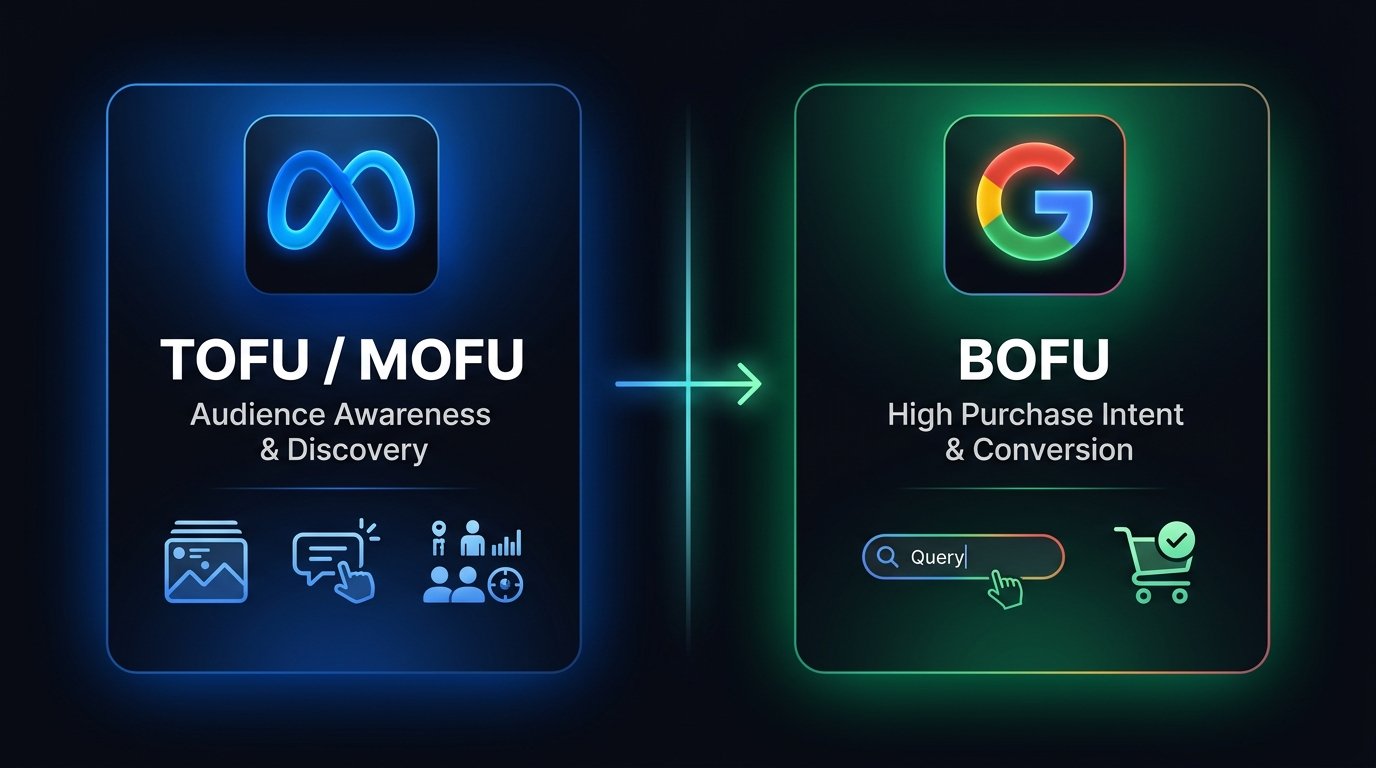
Google Ads dominates for capturing in-market purchase intent — it converts customers already searching for your specific category or SKU. Meta Ads dominates for demand generation and cold audience discovery — it positions your offer in front of hyper-relevant buyers before they even search. The most profitable e-commerce brands in 2026 do not choose between them; they deploy an integrated attribution engine where Meta feeds the top and middle of the funnel, and Google Shopping captures high-intent checkout conversions.
Every e-commerce founder eventually faces the same crossroads: should you bet your ad budget on Meta's billion-user social graph, or on Google's intent-driven search and shopping network? The answer has shifted dramatically since iOS 14, the rise of Meta's Advantage+ campaigns, and Google's Performance Max overhaul — and the conventional wisdom of 2021 no longer holds.
This guide cuts through the noise with a data-grounded comparison of both platforms across the metrics that actually matter for e-commerce profitability: ROAS benchmarks, funnel fit, targeting precision, creative requirements, and the budget allocation strategy that maximises compounding returns.
1. How Each Platform Generates Revenue: Fundamental Mechanics
Google Ads operates on explicit search intent. When someone types "best running shoes under £100" or "moroccan argan oil buy online," Google serves ads to people whose behaviour signals immediate purchase readiness. Google Shopping campaigns display product images, prices, and ratings directly in search results — capturing buyers at the exact moment of decision.
Meta Ads operates on interest and behaviour profiling. Meta does not wait for someone to search; it predicts who will want your product based on demographic data, purchase history, app activity, and lookalike modelling across 3.2 billion monthly users. Your ad interrupts a scroll — which means creative quality, hook strength, and offer clarity determine whether the viewer stops and converts.
2. Platform Comparison: 7 Key Metrics for E-Commerce
3. When Meta Ads Win: The 4 Critical Scenarios
Scenario 1 — New Product with No Search Demand: If you are launching a novel product category with zero search volume (e.g., a new beauty device or a niche subscription box), Google Search has no one searching for it yet. Meta's interest-based targeting and lookalike audiences let you create demand from scratch by reaching people who match your ideal buyer profile.
Scenario 2 — Visual, Aspirational Products: Fashion, jewellery, home décor, fitness, and beauty products thrive on Meta because the visual feed format lets you show the product in aspirational lifestyle context. A well-produced video showing someone wearing your jewellery at sunset converts far better than a text search ad.
Scenario 3 — Retargeting Warm Audiences: Meta's Custom Audience retargeting — serving ads to people who visited your site, added to cart, or watched 75% of your video — consistently delivers the highest ROAS in any e-commerce account. Warm audience retargeting on Meta typically generates 6x to 12x ROAS for well-structured funnels.
Scenario 4 — Subscription and High-LTV Products: Meta's optimisation for predicted LTV (lifetime value) rather than single purchase events makes it the superior channel for subscription boxes, SaaS trials, and products with strong repeat purchase rates.
4. When Google Ads Win: The 3 Clear Advantages
Advantage 1 — High-Intent Search Queries: Nothing beats Google when someone types "buy [your product] online" or "[product] near me." These buyers have already decided to purchase — they are just choosing which seller. Google Shopping places your product image, price, and rating directly in front of them at the exact moment of decision.
Advantage 2 — Established Product Categories: If your product category has strong monthly search volume (e.g., "men's leather wallets," "standing desk converter," "matcha green tea powder"), Google captures existing demand more efficiently than Meta because the user is actively seeking rather than passively scrolling.
Advantage 3 — Brand Defence: Every growing e-commerce brand must run Google Branded Search campaigns (bidding on their own brand name) to prevent competitors from stealing bottom-funnel searchers who already know and trust your brand. The CPCs are low; the ROAS is often 20x to 50x.
5. The Recommended Budget Split for E-Commerce Growth
Rather than choosing one platform, the most profitable e-commerce brands in 2026 use a channel-unified paid strategy:
- 60% – Meta Ads: Advantage+ Shopping Campaigns for cold acquisition, Custom Audience retargeting for warm/hot buyers, and lookalike expansion to scale winning ad sets.
- 30% – Google Shopping (Performance Max): Capturing in-market search demand with optimised product feeds, strong product titles, and clean GTIN/brand data.
- 10% – Google Branded Search: Defending your brand name from competitor conquesting and capturing high-intent branded queries.
Frequently Asked Questions
Should I run Meta Ads or Google Ads for my e-commerce store?
Run both. Google Ads captures people already searching to buy; Meta Ads reaches ideal customers before they search. The highest-performing e-commerce brands use Meta for top-funnel acquisition and retargeting, and Google Shopping for high-intent purchase capture. Together, they create a compounding growth loop.
What is a good ROAS for Meta Ads in e-commerce?
A healthy blended ROAS on Meta Ads for e-commerce ranges from 2x to 4x depending on margins and product category. Well-optimised Advantage+ Shopping Campaigns for fashion and beauty brands with higher AOV often see 3x to 6x ROAS. Warm audience retargeting can reach 8x to 12x.
How much should I spend on Meta Ads vs Google Ads?
A strong starting allocation is 60% Meta Ads (cold acquisition + retargeting), 30% Google Shopping (in-market capture), and 10% Google Branded Search (brand defence). Adjust quarterly based on actual CPA and contribution margin by channel as your attribution data matures.
Does Meta Ads work without the Facebook pixel after iOS 14?
Yes, but you must implement Conversions API (CAPI) server-side tracking alongside the browser pixel. Brands running CAPI with event match quality scores above 7 recover 20% to 40% of previously lost conversion attribution and see meaningful improvements in Advantage+ campaign optimisation speed.